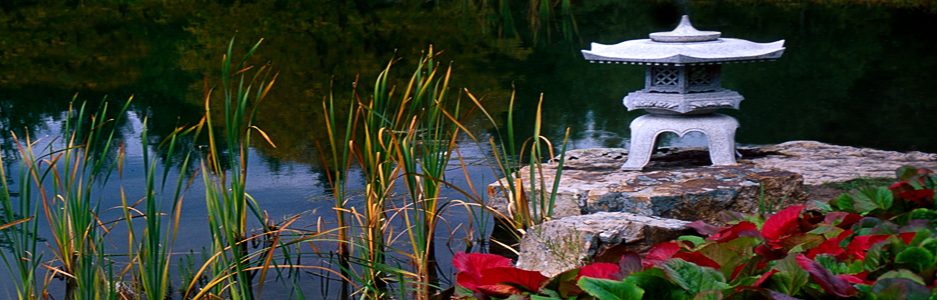
after tortured months of covid I’ve settled on “Rosinante” as the name not of my new steed but of my red camper
she’s loaded not with instruments of war but with canoe and bicycle and a beer-filled ice chest
we’re off to challenge not windmills but the waterways of Algonquin lakes
not to rescue damsels from dragons but to enjoy the flight of scarlet damselflies
my lure flies out
over clear blue waters
Plunk!
~ after Basho
Notes:
Haiku is after Basho’s: the old pond / a frog jumps in: / Plop! (trans. Alan Watts)
No one can really know what Basho had in mind when writing his (most famous) poem. I always wondered why various haijin over the years of haiku-in-English popularity thought it so exceptional, aka I didn’t really get it. After musing about it each time I came across it, and reading the thoughts of others about possible meanings, I’ve come to my own thoughts about the poem. An old pond can be thought of as the mindset of a travel-weary poet. As he wanders around a pond he hears the usual “noise” that keeps our attention from a mindful presence, the sound of a frog jumping in. The sound awakens him from his automatic musings (even Basho may have had “head noise”) and brings him into the “now” of the pond.
An early version of this haibun was written for a 50-words-or less challenge and published in Michael Rehling’s Failed Haiku: A Journal of English Senryu. The present version is 74 words.
I usually stick to the haibun format of title, one or more paragraphs, one or more haiku. But increasingly haiku and haibun websites are giving more free rein to alternative formats. I don’t claim that this is good free verse in form. I just wanted to write shot ditties en route to the final haiku.
About the Author
Ray Rasmussen has served as an editor for a variety of haibun journals. He currently is on the editorial staff of contemporary haibun online. His haibun, haiga and haiku have been published in numerous journals and some have been republished in anthologies. He lives with his partner Nancy in a cottage in a mixed hardwood Ontario forest acreage. Together they enjoy writing, fabric arts, photography, bicycling, canoeing and hiking.
I was asked to post a haibun and write a commentary on the nature of haibun for Abstract Magazine, an art-writing venue. The readers of this non-haiku genre journal were likely to be unfamiliar with haibun. I decided for a number of reasons to use “Unsaddled” as and example, and then explain how haibun is different than other short-in-length genres like flash fiction, prose poetry, essays, memoirs, and travel experiences.
Unsaddled
Ray Rasmussen
Breakfast without a newspaper is a horse without a saddle. —Edward R. Murrow
Unsaddled I am six months into my experiment of not reading the daily newspaper. Instead I read essays, including one by E.B. White, who, in response to Murrow’s metaphor, called breakfast “the hour when we sit munching stale discouragement along with fresh toast.” Breakfast is now more enjoyable, but I at times feel I’ve missed something important – that others know about events that I don’t, but should. Stretching Murrow’s metaphor, it’s me that’s unsaddled—riderless. This morning, as I walk the dog on a berm overlooking the freeway, there’s the usual tangle of commuters, all hurrying somewhere.
winter morning— the cat mews over her empty bowl
Previously published in Haibun Today.
Commentary on “Unsaddled”
My sense of the haibun genre is that it’s different than other popular short forms (memoirs, personal essays, travel experiences, flash fiction), in that haibun as practiced by most (not all) published writers is autobiographical – the characters and situations are drawn from the writer’s life, not made up.
Thus a reader should feel that “Unsaddled” is about a real time in my life. In many works of fiction, the writers aim at making events and lives seem real even when they’re made up, and and some haibun poets do the same. While most readers become involved with the fictional characters and their situations, they also sense when the work is made up, which establishes a distance, this isn’t quite real. That doesn’t mean it’s not a good story.
And even in haibun with its sense of reporting lived experiences, there is always a degree of embellishment. Some facts may be left out; other less-than-perfectly-true elements are put in. And some poetics are employed for effect. I have an unhealthy tendency to make my self come off as a better living in the moment than I am. That said, haibun is a confessional genre, aHowever, haibun in English, there is room for experimentation and evolution. Indeed, in the last decade, haibun that are clearly fantasy or accounts of dreams that we fabricated, and even some futuristic, sci-fi haibun are appearing.
I think of dreams and fantasy to fall in the auto-biographical mode, particularly if they’re quasi-accurate accounts of true dreams and fantasies or day dreams. Others might view dreams as excursions into fantasy that the dreaming mind creates.
Some haibun writers are producing fiction as if they are writing factual accounts of their own lives. Recently, one writer so convincingly conveyed a suicide impulse, that I, as to the editor, contacted the writer to ask if she needed help. The writer revealed the story was made up. In short, I can’t always tell the difference between fictional work presented as autobiography and close-to-the-truth accounts of a lived life, particularly when the writers are skilled.
On the other hand, some haibunists whose work I admire have taken issue with my preference that haibun be autobiographical. One of my favorite writers wrote: I often tell other people’s stories in the first person because I like the intimacy and immediacy of the voice. And even then I manipulate details for effect—whether for the story or the way the words end up on the page. And can’t tell which of her pieces are fictional and which depict real experiences.
Perhaps the most significant way that haibun differs from other short forms is the prose is married to one or more haiku (or tanka) poems. Haibun is a linking form and the nature of the linking is an important aspect of the writing. For example, a haiku that appears at the end of a prose passage isn’t just a three-line expression that is obviously related to the prose theme, and thus could easily be folded back into the prose. It’s meant to step out in some significant way, yet work with the prose to form a sum greater than the two parts: prose and poem.
Thus, Haibun carries the burden of needing to work with a worthy haiku, and not just any three-line aphorism, witticism or ditty. Yuasa has suggested: “… the interaction between haiku poetry and haiku prose is haibun’s greatest merit … The relationship is like that between the moon and the earth: each makes the other more beautiful.”
Various editors have indicated a number of ways this can occur, for example, while not containing a metaphor internally, a haiku may itself serve as a metaphor for aspects of the prose. Or the haiku may serve to close off the piece with a small poem that encapsulates the dominant feeling of the storyline. While some insist that the haiku must be able to stand on its own, without the prose, that’s a secondary concern of mine and others. I didn’t bother myself about whether the haiku in “Unsaddled” could find publication as a stand-alone in a haiku journal. I wrote the poem in the haiku form because I wanted it to fit with readers’ sensibilities of haibun as a coupling of prose and haiku, that is, the poem should follow the “rules’ of haiku” so to speak.
To name a couple of those rules, and these are more pronouncements, the poem should have the characteristics of succinctness and of showing more than telling. Most haiku couple two distinct images or phrases that work together to form the haiku, and most don’t contain poetic devices such as rhyming, metaphors or similes. Regarding the idea that the haiku should have a season word, the English-language form is evolving in many ways from it’s Japanese ancestors. I have an urban sensibility, so I and many contemporary writers don’t concern ourselves with season words (called kigo), a Japanese haiku orthodoxy stemming from its origins at a time when most Japanese lived in country settings. While the haiku in this piece does make a season reference to winter – an image fitting with aging and retirement – I’d not have minded a phrase that doesn’t so obviously reference a season.
I don’t concern myself with syllable counts or line lengths except to work to keep my poems between 10-15 syllables – short enough so they can be read aloud in one breath. The average length of contemporary English-language haiku is about 13 syllables. The 5-7-5 syllable count arose from the 5-7-5, 17-sound-unit count used by traditional Japanese poets which, in length, would be similar to a 13 syllable count in English.
In “Unsaddled,” the cat’s empty bowl references my feelings when I lack the daily news, particularly when others are talking about it. As such, it is meant to serve as a metaphor for the prose storyline. Note that the haiku usually don’t contain an explicit internal metaphor or simile which are usually signaled by the words “like” or “as.” Those are considered a waste of extra words.
This particular piece contains both an epigraph and an internal quote. A decade or so ago, one rarely saw either device being employed in haibun or in other non haike genres. While both practices are showing up more frequently in today’s haibun, there’s a danger in their use. For one thing, both Murrow and White have offered very clever quips about the daily news and both are (or were) well-known writers. So the quality of their words could become the story, with my words but fluff surrounding them. I do hope in this haibun to have added something to their words yet not to have allowed their two quips to get in the way of my storyline. Another aspect is that I admire White’s writing and Murrow’s musings, and I wanted to bring these two luminaries from the last century back to life, so to speak, for today’s readers. In this, I am copying Basho who often referenced the works of Japanese and Chinese poets from earlier eras.
Finally, I’d like some of my haibun to offer readers the possibility of identification and introspection, as in, here’s something to think about in the context of your own lives. While a young person will not likely identify with my experiences in reading the news, I think that many middle-aged and older retirees will. If I share something real about my inner world, perhaps others will find it to be of value. And today, with the entry of Donald Trump onto the world and crazed politics, how could most people not identify with the consistent awfulness of the news? [It Beatles who famously sang “I read the news today, Oh Boy!”] Yet most of us are glued to that dismal news, offered daily and even hourly through numerous media. And yes, at times I’ve gotten back to reading the news, and I’m coming to regret it.
As a final point, no story is just a story. In some cases, I offer challenges to an orthodoxy being advocated by another writer. “Unsaddled” is an example of didactic writing in that I’ve presented what I consider to be an expansion of and even challenge to the ideas of White and Murrow.
2) My haibun, “Unsaddled,” was first published in Haibun Today, January 6, 2008.
3) Both the Murrow and White quotes in “Unsaddled” are taken from E.B. White, “Newspaper Strike,” The New Yorker Archives, December 12, 1953. For those interested in reading more work by E.B. White, try One Man’s Meat, and Essays of E.B. White. Edward R. Murrow was an American broadcast journalist and war correspondent who came to the nation’s attention as the radio voice from a beleaguered London during the Blitz and air Battle of Britain. His compassionate reports contributed to the pro-Allied sympathies that were growing even before Pearl Harbor. Worth listening to and reading, especially in these times is Murrow’s broadcast response to accusations made by the infamous Senator McCarthy that Murrow was left-leaning. McCarthy had led a lengthy witch-hunt for American communists. Murrow’s comments can be read and heard here: Murrow Broadcast
4) The earth/moon quote is taken from Nobuyaki Yuasa’s introduction to his book, Matsuo Basho, The Narrow Road to the Deep North and Other Travel Sketches, Penguin Classics, 1966.
5) For an expanded discussion of the relationship between prose and poem, read “A Haibun Editor Suggests,” an essay in Ken Jones Zen website.
“Love . . . I recall the time when you pierced me. It was that sweet, irrecoverable time, when to youth’s eyes, the world’s unhappy landscape smiles like a vision of paradise.”~ Giancomo Leopardi(1798-1837)
Strapped into a too-narrow, no leg-room Air Canada seat, I’m editing a manuscript. The distinguished-looking fellow beside me looks over and, in a strong Italian accent, says, “Are you a writer or editor?”
“I’m revising some of my writing,” I reply, and hand him a copy of my last haibun collection, hoping it will keep him quiet while I work.
He starts thumbing through, and I can’t help but notice how little time he stays on each page. Is it that bad? I’m thinking.
But he surprises me with, “I see what you’re doing. This type of writing, haibun is it, is demanding of the reader. In the prose part, you’re telling a story, which they’d like because they’re used to being fed stories on TV. But that tiny poem at the end of the prose invites them to step out of their cocoons, to make connections.” It would be useful to add haibun examples when I teach poetry forms because it causes readers and students to think about the relationship of a tiny poem to the title and prose part of the haibun.
“Students? Do you teach in English?” I ask.
“Romance Languages and poetry at the University of Toronto,” he says.
Damn, I’ve handed my work to an academic who writes. poetry and produces literary criticism. What must he really think?
“You’re Italian, yes?” I ask. He nods, and I mention that my mother is of Italian heritage, but her parents had died in the Spanish Flu. Raised in an orphanage, she hadn’t learned her parents’ language.
“No!” he exclaims, “Terrible to lose your language, your treasured heritage!” He names a number of Italian poets, “Do you know any of them?” And without pausing for my answer, says, “Listen! This is Giacomo Leopardi’s poem ‘First Love.’” And he recites it in Italian and then a translation in English.
The poem’s rhythms are musical, and his hands and arms dance, as if driven by an internal puppet master conducting Leopardi’s music for me, an audience of one.
His accent and gestures remind me of those rare visits with my aunt and uncle, Laura and Tommaso Terranova, who regaled us with stories of the old world.
so little English
yet their hands
sing many stories
He squeezes my arm and confides: “My wife tells me I talk too much. Let me know if I’m boring you and I’ll shut up.”
But I gratefully put my editing aside and we chat for the remainder of the flight.
dinner at home –
hands shape
our family’s heritage
Notes
Published in Contemporary Haibun Online, 19.1 2023.
The title is taken from Steven Spielberg’s Close Encounters of the Third Kind, a 1977 science fiction film. It tells the story of a blue-collar worker in Indiana, whose life changes after an encounter with an UFO.
The epigraph is a translation of lines taken from Giacomo Leopardi’s “A Solitary Life,” published in The Canti, in Poetryintranslation website. Italian scholar, poet, essayist and philosopher, Leopardi was one of the great writers of the 19th century. Leopardi’s love problems inspired some of his saddest lyrics. Despite having lived in a small town, Leopardi was in touch with the main ideas of the Enlightenment movement. His literary evolution turned him into one of the well known Romantic poets. (Information taken from the GoodReads website)
Issa and I have resided in this remote Ontario cabin for a month now. He speaks to me through his writing and accompanies me on my walks. I speak to him by writing about his poetry. Today, he’s lecturing me on compassion:
don’t worry spiders
I keep house
casually
~ Issa
So instead of engaging in my usual spider mayhem by employing the broom as a weapon of web destruction, I try to keep spidy and friends at a comfortable distance as I write this haibun and commentary based on an excerpt from Issa’s travel journal, Oraga Haru.
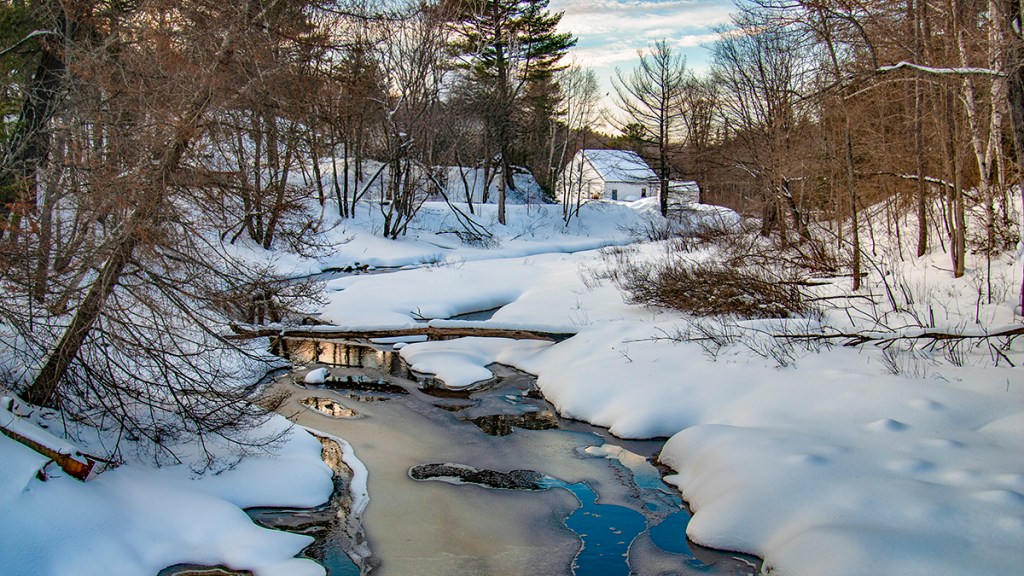
Finished writing for the day, I don snowshoes for a walk. The wildlife tracks are numerous: fox, deer, coyote, porcupine, rabbit, squirrel, endearing tiny tracks, and for the first time in a long while, wild turkey . . . and I wonder how a wild turkey would taste . . .
don’t worry turkeys
I hunt
quite ineptly
~ ray rasmussen (after Issa)
Back in the cabin, the radio informs me about the corona virus pandemic. And Issa shares some of the angst of his era …
in this world
we walk on the roof of hell,
gazing at flowers
~ Issa
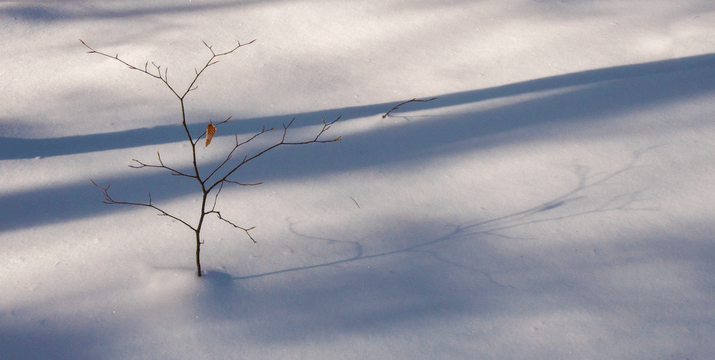
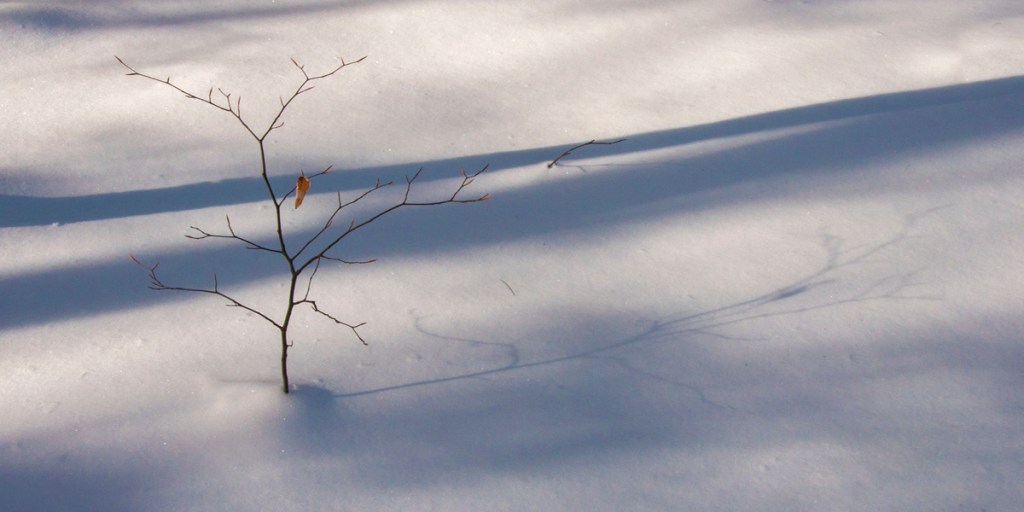
It’s winter, Issa, no flowers here. Will this leaf hanging from a small shrub do? Today I’m capturing images of the bluish tree shadows cast by the setting sun. I can’t help but feel remiss in my compassion for humanity while enjoying winter’s sublime beauty.
in this world,
a virus plagues our minds,
gazing at tree shadows
~ ray rasmussen (after Issa)
I look out at the maple, ash and oak trees, all stripped of their leaves, and see myself, self-isolated, stripped of friends and obligations, and yet some weathered leaves have remained through winter on the beech trees, just as warm memories of friends and family have remained in my heart while away.
And so Issa shows me a way through adversity:
what good luck!
bitten by
this year’s mosquitoes too
~ Issa
Thank you, Issa mentor-friend . . .
what good luck!
yet another day refreshed
by frigid winds
~ ray rasmussen (after Issa)
~ end ~
Notes
The haiku by Issa are translations by Robert Hass. My 3-line poems are modelled on Issa’s.
The commentary on Issa’s haibun that I referenced in the haibun above appears as a feature in A Hundred Gourds 3:3 June 2014.
Below is an excerpt (with a few modifications) about the life of Kobayashi Issa taken from David G. Lanoue’s Haiku Guy website. If you’d like to know more about the poet that many Japanese think of as their favourite haiku master or peruse many of Lanoue’s translations of Issa’s haiku, the Haiku Guy website is the place to visit.
Koybayashi Issa (1763-1828) practiced the art of haiku (then called haikai) as he wandered the length and breadth of Japan. Though his real name was Kobayashi Yatarô, he chose Issa (Cup-of-Tea) as his haiku name. He also referenced himself as “Shinano Province’s Chief Beggar” and “Priest Cup-of-Tea of Haiku Temple.” His work was imbued with Buddhist themes: sin, grace, trusting in Amida Buddha, reincarnation, transience, compassion, and the joyful celebration of the ordinary. ~ David G. Lanoue (statement modified a bit by Ray Rasmussen)
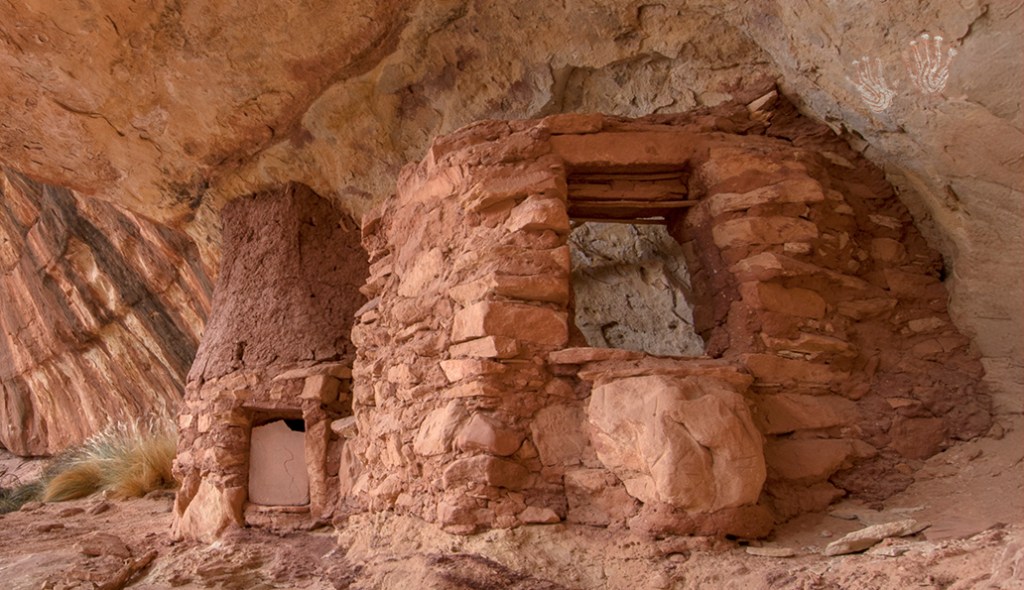
Here, in this remote, twisted canyon, countless generations of aboriginal puebloan peoples lived. One thousand years ago, they faced a 100-year drought, and lost out to it. It’s likely that some farmers became nomads, raiding the produce of others who had struggled on; likely there were skirmishes in which one family battled another for survival.
scattered pot shards all that remains of a nameless family
I rest in an alcove’s shade near crumbling walls of stone and mud located high on a sandstone cliff. Ghostlike handprints are painted above the doorway. Below is the wash whose intermittent waters fed their small plot. Where corn and squash once grew, there’s nothing but cactus.
I listen to the wind whispering, imagine it’s them speaking of their failing crops while sharing a scant evening meal.
I don’t know who these tears are for.
sheltering in the broken walls a whiptail lizard
Notes: Published in Haibun Today 5:4 December 2011
This haibun was inspired by the chinese poet Du Fu’s “Days End”. I used his simple structure and put in my on theme related to my visits to the (sometimes intact) ruins left by the ancestral puebloans of the four-corners region of the United States.
I’ve resided in a remote Ontario cottage for several weeks. Yesterday, a blizzard was blowing and so I stayed in and enjoyed conversing with Issa via the medium of his translators’ books. As I read and write notes, I notice a particularly ominous spider web and remember that Issa offers this haiku for consideration . . .
Don’t worry spiders I keep house casually ~ Issa
And instead of engaging in my usual spider mayhem by employing the broom as a weapon of web destruction, I keep my eye on the spider and move my desk a comfortable distance away while I continue to read Issa’s travel journal, Oraga Haru (The Spring of My Life).
Today the sun is out and I don snowshoes and come across numerous tracks: wild turkey, fox, deer, and porcupine . . . and, again, recalling Issa’s haiku, mentally compose derivatives. This is one I felt came close, since it closely replicates Issa’s, yet has my own context.
Don’t worry turkeys I hunt ineptly ~ after Issa
As Issa and I move through a mixed hardwood forest we come across a wildflower meadow, which brings to mind a walk last summer with Nancy, my partner, whom I’m missing.
Issa offers these thoughts on flower gazing . . .
We walk on the roof of hell, gazing at flowers ~ Issa
No wildflowers here in winter, Master Issa, but I’m taking photographs of the long blue-grey tree & shrub shadows cast by the setting sun. And yes, I agree, photographing scenes is akin to enjoying flowers while ignoring humankind’s woes. And, having confessed, I went about building my own version of Issa’s haiku.
We live in a world of chaos, while building snowmen ~ after Issa
On my last evening with Issa, I look out at the leafless trees, and think about how for a month I’ve shed routines, obligations, news reports and friends – no phone or email here – and felt the dual pains of loneliness and regrets.
And Issa, I know from the biographies of your life, you had many painful experineces to overcome, and I read that you offered your thoughts on transcendence:
What good luck! Bitten by This year’s mosquitoes too. ~ Issa
True enough, Issa, may I call you ‘friend’. Although bitter cold, this has been a good winter retreat for beauty, your companionship and contemplation of your sense of compassion and thoughts about transcendence.
What good luck! Chilled by This winter’s biting cold too. ~ after Issa
afterword:
I wrote this piece with the view in mind that it would do more for me to try to write haiku (and haibun for that matter) with Issa’s work as a model than to simply enjoy reading Issa’s work and leave it at that. While I like some of my derivative haiku above, I don’t like all of them. While I think Issa’s last haiku, for example, works, I don’t think my derivative is as accessible as is the irony in his. And, I’m pretty certain that if the editors of a haiku journal looked at my derivatives without having known about or ever seen any of Issa’s work, they’d not accept my three haiku derivatives as good enough to publish. But, after all, Issa wasn’t appreciated in his day by the other prominent haiku masters and pundits of his day.
What about haiku orthodoxy. If you scour the Internet for the ‘what is’ and ‘how to’ of haiku, a common pronouncement is that you mustn’t personify animals and inanimate objects. Did you notice that Issa is breaking that “rule”? He’s personifying spiders by speaking to them. His second haiku also breaks the “rules.” It’s more a philosophical musing than a focus on immediate images drawn from his environment. His third haiku is a clever bit of wit, what some would call a ‘ditty’ or ‘witticism.” And thus some editors will insist it’s a senryu, a haiku in form, but not a pure haiku … it’s more focused on humour and sentiment than the natural world.
Here’s a comparison of a haiku of mine that was published in Modern Haiku that used some of the same natural context, but that the editor accepted as focused on the natural world.
monkshood bloom – the whine of mosquitoes seems diminished
Both mention mosquitoes, but Issa’s strikes me as a bit removed from nature and, again, more of a philosophical musing.
Isn’t derivative writing also a bad thing?
If you’re interested in this idea that you can expand your own writing repertoire by modelling the work of other writers (and acknowledging that you’ve done so), you might be interested in my article on the subject that appeared originally in Contemporary Haibun Online: The Role of Modelling in Haibun Composition.
notes:
The haibun was previously published in the A Hundred Gourds journal.
The haiku in italics are by Kobayashi Issa (Trans. Robert Hass).
If you enjoy Issa’s haiku, a website I often visit is David G. Lanoue’s “Haiku of Kabayashi Isssa.”
The two tranlations of Oraga Haru I read and relied on are: Sam Hamil, Kobayashi issa: The Spring of my Life and Selected Haiku; Nobuyuki Yuasa, The Year of My Life: A Translation of Issa’s Oraga Haru.
. . . if they fail to express what is in their own minds, what is the use, no matter how many poems they compose! ~ Ryokan
The doorbell rings. On the porch, standing in a downpour, is a very wet girl in baggy clothes. Her hair is mouse-brown with red and green streaks, her face festooned with shiny bits of metal and orange lipstick and an alarming red rash.
She can’t be selling Girl Guide cookies. What’s this about?
“Yes,” I say.
“Hi, I’m Lisa, Janey’s friend. Is she home?” She leans in trying to peek around me.
Janey’s friend, uh oh! Why is she here?
Janey rushes up to the door. “Dad, this is Lisa. She’s the one I told you about.” Her voice lowers. “You know . . . from rehab.”
Lisa? Maybe late teens? Maybe Crystal Meth? Was she Janey’s special friend who shared red licorice and TV in rehab?
“Hi Lisa, come in,” I say with little enthusiasm.
Head down, Lisa enters, mumbles “thanks.”
Janey jumps in again: “Dad, I said she could come over. She needs to get away from her boyfriend, like I needed to, you know, get away from Johnie, so I could get clean.”
Just a boyfriend? maybe a pimp? a drug dealer? Violent? Will he show up here looking for her? Damnit! Janey promised to stay away from those street kids.
Reading my silence as leading to a “no”, Janey jumps in again: “Dad, Lisa’s got nowhere to go. Can’t we help her?” said in the same wheedling voice she had used for getting a second bedtime story.
For how long? What about her parents? Why not rehab? Or a shelter? And what are those red spots? Hives? Measles?
“Lisa, Tha’s quite a rash, you have,” I say. Are you feeling okay?”
Janey says: “Dad, they’re just Speed bumps, meth does that,” she explains, with the same authority as when she identifies the birds that come to the feeder she put up in our backyard, trying to help them through the winter.
Janey has always been a rescuer. I’ve encouraged her, thinking that if she cares for something or someone else, maybe she’ll begin to care for herself.Maybe this is an opportunity?
pouring rain, and also pouring in so many maybes and what-ifs. yet has a bit of hope also seeped in?
who said, “hope is a thing with feathers that perches in the soul?” perhaps someone, like me who needs to hope again.
“I was just fixing dinner,” I say to them. “Janey, why not take Lisa to your room and get her some dry clothes and then let’s sit down, have dinner and talk.”
Much later, after many conditions stipulated and seemingly agreed to, we’ve gone to a store where the girls bought the necessities: hair and tooth brushes, underwear, tops and pants. And that night, they retreat to the TV room, and I give them the bag of red licorice I bought for them while they were shopping.
just two girls, yet so much more, sunk deep in the sofa giggling while watching TV and sharing red licorice
a morning walk with the black dog. maybe the spring flowers are up, Dare I hope for the flash of a yellow warbler?
About the Author
Ray Rasmussen resides in Edmonton and Halton Hills, Canada. His haibun, haiga, haiku and articles have appeared in the major print and online haiku journals and anthologies.
My daughter’s ashes are now spread in places she loved, although I have a hard time remembering when she loved anything but drugs, and lived anywhere but on the streets.
We did our best, I’ve often thought to myself and even said aloud as we spread her ashes in a mountain meadow. You could have done better, another voice always answers.
“Keep your chin up,” a friend recently said, “You’re not responsible for her choices in life.”
I read that the first printed reference of “keep your chin up” comes from a 1900 edition of a Pennsylvania newspaper. The remainder of the quip is, “Don’t take your troubles to bed with you – hang them on a chair with your trousers or drop them in a glass of water with your teeth.”
teeth full of
caps and fillings.
those restive nights after
viewing photos of the places
she loved
Published in Contemporary Haibun Online, 19:3, 2023.
The sun’s rays filter through a stand of spruce where twenty horses are hitched. As we unpack them, Dave, a lanky outfitter, and I chat about the grizzly we spotted earlier in the day and how the horses are holding up.
men’s talk – the smell of sweat and manure
Dave asks, “Ray, what are you up to these days?”
I’m embarrassed to say that I receive a monthly check without having to work, that I no longer wake up by an alarm clock, that I feel guilty about those who have to rush breakfast and fight traffic, that I view my avocations as luxuries in a world stressed by war and poverty.
Finally, I say: “Well, I write a bit and do some photography.”
Dave replies, “Oh, do you sell your photographs?”
“Some, but not enough to pay for the camera.”
So there it is. I can’t simply sit on the back stoop and admire the lawn growing, the shadows lengthening.
“Well,” Dave grunts as he hefts a 60-pound load off the horse, “must be nice to have time to pursue your interests.”
How many times have I heard that I now have time to be the writer I always wanted to be, to travel as much as I want?
In younger times I was a jock, a professional, a dad, a leader and a teacher. Now I’m a retiree, a senior, a grey beard, all of which carry undertones of geezer, hints of useless.
The horses don’t like being corralled, and I don’t either. When we release them, they race out into the meadow, roll in the black loam, shake and begin to graze.
I wish this rawness I feel could as easily be shaken off.
monkshood bloom – the whine of mosquitoes seems diminished
Note: Haiku first published in Modern Haiku. Haibun with haiku later published in Lynx Haiku Journal.
Hell isn’t merely paved with good intentions: it’s walled and roofed with them. Yes, and furnished too. ~ Aldous Huxley
We’re dining on ginger beef and cod in black bean sauce, flavored with catch-up chat. My friend Kathy, leans toward me and says, “I think you’re just about to have an important birthday. Yes?”
I tell her my age and, excited now, she says: “I thought so. Why don’t I organize a party to celebrate your milestone?”
Milestone? The word was coined for the stone obelisks placed by those great builders, the Romans, to mark distances along the many roads branching out from Rome.
age-worn stone
the emperor’s name
unreadable
“If you set up a milestone gathering, have a good time and say hello to everyone for me,” I reply.
“What – you wouldn’t want to celebrate with your friends?” she asks.
“It’s the idea that I’ve done something extraordinary to reach my present age, like conquering a new territory, and thus deserve a tribute where I parade my army, plunder, and slaves through streets lined with cheering citizens. A milestone party would invite congratulatory comments like ‘You’ve made it to a magic age,” lead to questions like ‘What’s on your bucket list – going sky diving?”
“Do you mean you think they’d not be sincere?” she asks.
“When I look at someone my age, even when they’re still mentally and physically active, I feel a sadness about their diminishment. On my last hiking trip, a middle-aged companion said, ‘Ray, I sure hope I can be as active as you when I’m your age.’ Tongue in cheek, and secretly irritated, I replied, “I’m confused. I’m only 35.” I knew it was intended as a compliment, but I was thinking, There are downsides to reaching my age, the small infirmities that, like weathered milestones, ruthlessly mark diminishment’s path.
“Okay,” she replies, “no milestone-theme party, but I’d like to do something.”
“Agreed. I’d enjoy a gathering celebrating everyone, each person who wants sharing what’s going on in their own lives”
my winter is just this –
a pair of goldfinches
still visiting the feeder*
“You’d not want any comments on your birthday?” she asks.
“If people feel they must say something, I’d prefer honesty, preferably with humor, like Hal’s greeting the other day when I met him for coffee: ‘Damn, but you look grizzled, shaggy white beard, wild hair. Looks like you’ve been in a wind storm.’”
She laughs. “I’ll bet it was you looking in the mirror talking to yourself.”
You’re right, I looked and said: “I’m happy to be here and yet I feel guilty about having my cosmic dice roll so many 7s.”
awaiting cremation –
birthday cards line
the fireplace mantel