One doesn’t see an abundance of ekphrastic haibun in contemporary journals, but they do appear from time to time in various journals and collections. It’s my view that ekphrasis in haibun composition could, and even should play a more prominent role in our collected literature. I also think that the practice of ekphrasis is a useful way for writers to develop their haibun composition skills.
To explore the practice of ekphrasis, I’ll focus on one piece, Peter Butler’s “Instructing the Mona Lisa” in order to gain an insight into one approach to ekphrastic writing and as a springboard to discussing the technique of ekphrastic haibun.
The word “Ekphrasis” comes from the Greek ek and phrasis, ‘out’ and ‘speak’ respectively. Initially, Greek philosophers used the practice of ekphrasis to expand their students’ rhetorical repertoires by learning to bring the experience of an object to a listener or reader through highly detailed descriptive writing or oration. (1)
Instructing Mona Lisa
Relax, Lisa. Not quite facing me, more a half-glance. Nails clean? Then hands on lap, right over left. As to expression, no laughing please without your teeth. Lips together.
Now imagine yourself in a post-coital situation—not with me, of course, nor necessarily your husband.
That is perfect, Lisa. Hold it if you can, several hundred years.
gallery attendant
checking the time
to his next break
From its title, the haibun’s subject will be obvious to most, if not all, readers. Most will also be able to produce a mental image of the Mona Lisa’s enigmatic smile.
Currently ekphrasis refers to the use of a writer’s own literary genre (e.g., free verse poetry or haibun or tanka prose or prose poetry) to reflect on another art form (e.g., a painting or a stained glass window or a sculpture ). (2) Where a free verse or a haibun poet might pen a piece about a walk in a wildflower meadow (nature’s artwork), an ekphrastic piece would be about the writer’s projection into a watercolor of a wildflower meadow (a painter’s artwork). In general, the ekphrasis won’t consist of a simple description or literal translations of the painting, but instead modern ekphrastic writing serves as a creative bridge authors use the form to interpret symbolic meanings, impose new narratives, confront the historical context of a piece, or reflect their own emotional and psychological responses to the artwork. [1, 2, 3, 4, 5]
Ekphrasis has a long history in poetry, but ekphrastic haibun have appeared only recently. Modern ekphrastic poems have generally shrugged off antiquity’s use of elaborate description as in the case of Homer’s detailed description of Achilles’ shield. Instead, poets have tried to interpret, inhabit, confront, and speak to their subjects as a springboard to a poetic expression.
One that is unusual in content and that I found quite entertaining is Peter Butler’s “Instructing Mona Lisa”:
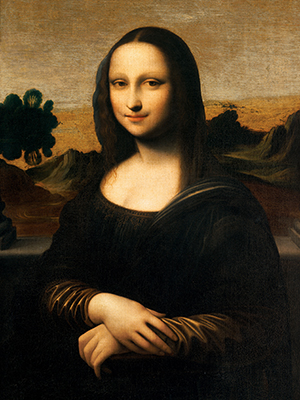
Butler’s first paragraph is both inventive and replete with descriptive detail. He imagines himself to be a painter with Madonna Lisa (who he calls “Lisa”) sitting for him. The charm of the piece comes with his instructions:
Relax Lisa. Not quite facing me, more a half-glance. Nails clean? Then hands on lap, right over left. As to expression, no laughing please without your teeth. Lips together.
As can be seen, his description fits perfectly with her demeanor.
In the second paragraph, Butler abandons descriptive detail and makes a further leap of inventive fancy that creates a shift in the mood to ribald. His protagonist suggests:
Now imagine yourself in a post-coital situation—not with me, of course, nor necessarily your husband.
The third paragraph delivers a witty punch line:
That is perfect, Lisa. Hold it if you can, several hundred years.
This serves as another shift, taking us back to the reality of the writer sitting at his keyboard spinning fantasy.
The haiku anchors us further in reality. The first phrase (“gallery attendant”) places Butler sitting in the Louvre (or any gallery or even at home looking at a reproduction). The second phrase (“checking his time / to the next break”) uses time to bring us back to the present.
gallery attendant
checking the time
to his next break
Readers can spin off in different directions. Here’s mine: the guard spends a work-day lifetime among the paintings and viewers and I can’t imagine anything but boredom. But viewing art can become boring even for those (myself included) who have a difficult time spending more than an hour or two in a gallery. Perhaps with Butler-type fantasy-projection as a helpmate, I could last with “Lisa” a bit longer.
Butler’s take on the Mona Lisa captured my interest more than the plethora of art criticism that has been done on it and in particular the speculations about what that smile might mean. In short, he’s gotten me to take a closer look at a painting that I’d stopped being willing to give more than a passing glance.
A good deal has been suggested recently about the role of the title in haibun. Robert Beary, Haibun Editor of Modern Haiku thinks a title should be more than the one offered by Butler:
In haibun, the wrong title is like a wrong number. It makes the reader want to hang up the phone. A haibun’s title should be strong enough to draw the reader into the prose and make the reader want more. Let the title be a link to the prose and the haiku, not give away the rest of the piece. After reading the entire haibun, the reader should be able to look at the title and see more than one meaning.
For myself, I think that Butler’s title serves well enough to orient the reader about what’s to come. But some readers likely prefer less direction, a title that isn’t so predictive, allowing the piece to unfold more slowly.
I’d like to see more writers occasionally stray from more traditional approaches and give invention, of which ekphrasis is one form, a try. I did a survey of the haibun and tanka prose appearing in the 2013 year’s issues of A Hundred Gourds, Contemporary Haibun Online and Haibun Today and found that of the 626 total haibun and tanka prose that appeared, only 19 were ekphrastic pieces (3% of the total) and 6 of those 19 were by one writer. Of course, there were other types of imaginative writing.
Poet Martin Porter provides a motive for trying ones hand at ekphrastic writing:
Finding ‘stuff” to write about can be difficult. The notions of “writing what you know,” “write what you see around you” and “write from experience” are all good in principle, but when these sources seem exhausted, dry or repetitious and unchallenging, it can be useful to take a break and borrow material from somewhere else.
I’d go further than Porter. Most haibunists live in urban environments that provide little access to natural settings, and with lots of access to humankind’s rich accumulation of artwork. Museums, art galleries, statuary, architecture and even expressive graffiti are part of this heritage. Thus, for inspiration, one type of contemporary ginko can be thought of as a museum or gallery visit, a walk around the town square, or even an evening by the fire with a photography book.
Butler’s brand of inventive wit made my day as reader and editor. I enjoy pieces with rays of lightness as a balance to the more somber tones that dominate our genre. While some definitions of haibun mention humor, my sense is that there’s very little humor or wit to be found in the pages of our journals. How about we lighten up a bit!
. .
Notes:
“Instructing Mona Lisa” first appeared in Haibun Today 6:4, December 2012.
Peter Butler’s newly released collection contains a different, expanded version of “Instructing Mona Lisa.” Peter Butler, The Trouble with Mona Lisa: A Haibun Collection, 2015, paperback: 64 pages, can be purchased through Alba Publishing.
To see Homer’s ekphrastic poem and an image of Achilles’ shield go to “The Shield of Achilles.”
For more a formal art criticism discussion about the Mona Lisa, visit the Art and Critique website.
Roberta Beary’s comments on haibun titles are found in “The Lost Weekend,” Frogpond, Volume 34:3 2011.
Martin Porter, “Notes on Ekphrasis,” Poetry Notes and Jottings website, December 19, 2012.
Passages above on Ekphrasis were taken from a number of sources, including: “Ekphrasis: Poetry Confronting Art,” taken from the American Academy of Poets online site Poets.Org.

