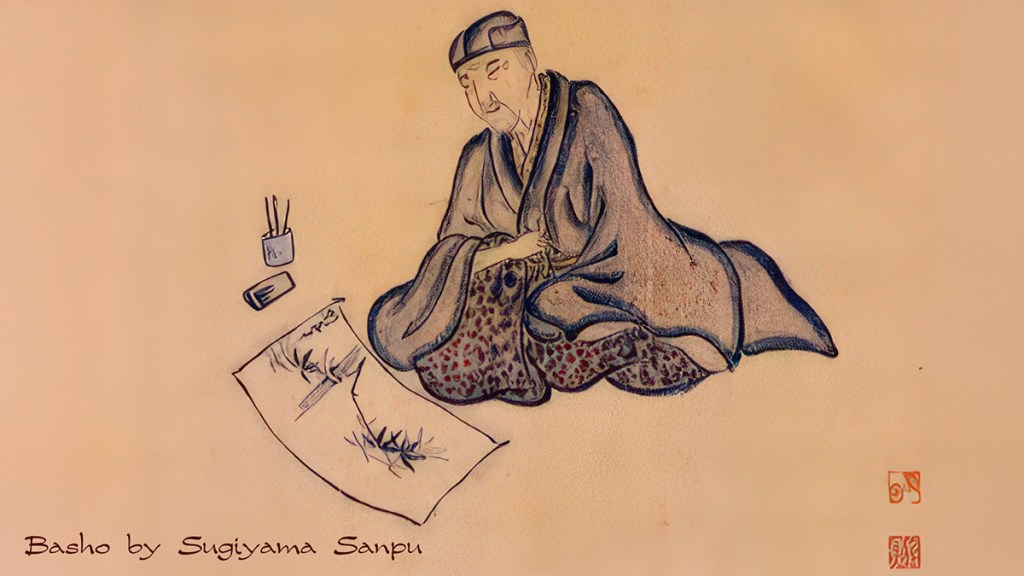
Introduction: The Hut of the Phantom Dwelling , which Basho rewrote a number of times in 1690, is considered the first outstanding example of haibun literature. Earlier haibun tended to be extremely short and to function primarily as salutations. But The Phantom Dwelling , which was closely modeled on Kamo no Chomei’s prose essay “Ten-Foot Square Hut” ( Hojoki , 1212), is an extended prose poem in a highly elliptical, hybrid style of vernacular, classical Japanese and classical Chinese, with Chinese-style parallel words and parallel phrases.
The Hut of the Phantom Dwelling
Matsuo Basho, trans. Burton Watson
Beyond Ishiyama, with its back to Mount Iwama, is a hill called Kokubuyama — the name, I think, derives from a kokubunji, or government temple of long ago. If you cross the narrow stream that runs at the foot and climb the slope for three turnings of the road, some two hundred paces each, you come to a shrine of the god Hachiman. The object of worship is a statue of the Buddha Amida. This is the sort of thing that is greatly abhorred by the Yuiitsu school, though I regard it as admirable that, as the Ryobu assert, the buddhas should dim their lights and mingle with the dust in order to benefit the world
Ordinarily, few worshipers visit the shrine, and it’s very solemn and still Beside it is an abandoned hut with a rush door Brambles and bamboo grass overgrow the eaves; the roof leaks; the plaster has fallen from the walls; and foxes and badgers make their den there. It is called the Genjuan, or Hut of the Phantom Dwelling. The owner was a monk, an uncle of the warrior Suganuma Kyokusui. It has been eight years since he lived there — nothing remains of him now but his name, Elder of the Phantom Dwelling.
I, too, gave up city life some ten years ago, and now I’m approaching fifty I’m like a bagworm that’s lost its bag, a snail without its shell I’ve tanned my face in the hot sun of Kisagata in Dewa and bruised my heels on the rough beaches of the northern sea, where tall dunes make walking so hard.
And now this year here I am drifting by the waves of Lake Biwa. The grebe attaches its floating nest to a single strand of reed to keep it from washing away in the current. With a similar thought, I mended the thatch on the eaves of the hut, patched up the gaps in the fence, and, at the beginning of the Fourth Month, the first month of summer, moved in for what I thought would be no more than a brief stay. Now, though, I’m beginning to wonder if I’ll ever want to leave.
Spring is over, but I can tell it hasn’t gone for long. Azaleas continue to bloom, wild wisteria hangs from the pine trees, and a cuckoo now and then passes by I even have greetings from the jays and woodpeckers that peck at things, but I really don’t mind — in fact, I rather enjoy them. I feel as though my spirit had raced off to China to view the scenery in Wu or Chu, as though I were standing beside the lovely Xiao and Xiang Rivers or Lake Dongting. The mountain rises behind me to the southwest, and the nearest houses are a good distance away.
Fragrant southern breezes blow down from the mountaintops, and north winds, dampened by the lake, are cool I have Mount Hie and the tall peak of Hira, and this side of them the pines of Karasaki veiled in mist, as well as a castle, a bridge, and boats fishing on the lake. I hear the voice of the woodsman making his way to Kasatori, and the songs of the seedling planters in the little rice paddies at the foot of the hill Fireflies weave through the air in the dusk of evening, clapper rails tap out their notes — there’s surely no lack of beautiful scenes.
Among them is Mikamiyama, which is shaped rather like Mount Fuji and reminds me of my old house in Musashino, while Mount Tanakami sets me to counting all the poets of ancient times who are associated with it. Other mountains include Bamboo Grass Crest, Thousand Yard Summit, and Skirt Waist. There’s Black Ford village, where the foliage is so dense and dark, and the men tend their fish weirs, looking exactly as they’re described in the Man’yoshu .
In order to get a better view all around, I’ve climbed up the height behind my hut, rigged a platform among the pines, and furnished it with a round straw mat I call it Monkey’s Perch. I’m not in a class with those Chinese eccentrics Xu Juan, who made himself a nest in a crab apple tree where he could do his drinking, or Old Man Wang, who built his retreat on Secretary Peak. I’m just a mountain dweller, sleepy by nature, who has returned his footsteps to the steep slopes and sits here in the empty hills catching lice and smashing them.
Sometimes when I’m in an energetic mood, I draw clear water from the valley and cook myself a meal. I have only the drip, drip of the spring to relieve my loneliness, but with my one little stove, things are anything but cluttered. The man who lived here before was truly lofty in mind and did not bother with any elaborate construction. Besides the one room where the Buddha image is kept, there is only a little place designed to store bedding.
An eminent monk of Mount Kora in Tsukushi, the son of a certain Kai of the Kamo Shrine, recently journeyed to Kyoto, and I got someone to ask him if he would write a plaque for me. He readily agreed, dipped his brush, and wrote the three characters Gen-ju-an . He sent me the plaque, and I keep it as a memorial of my grass hut.
Mountain home, traveler’s rest — call it what you will, it’s hardly the kind of place where you need any great store of belongings. A cypress-bark hat from Kiso, a sedge rain-cape from Koshi — that’s all that hangs on the post above my pillow.
In the daytime, I’m once in a while diverted by people who stop to visit. The old man who takes care of the shrine or the men from the village come and tell me about the wild boar that’s been eating the rice plants, the rabbits that are getting at the bean patches, tales of farm matters that are all quite new to me.
And when the sun has begun to sink behind the rim of the hills, I sit quietly in the evening waiting for the moon so I may have a shadow for company or light a lamp and discuss right and wrong with my silhouette.
But when all has been said, I am not really the kind who is so completely enamored of solitude that he must hide every trace of himself away in the mountains and wilds. It’s just that, troubled by frequent illness and weary of dealing with people, I’ve come to dislike society.
Again and again I think of the mistakes I’ve made in my clumsiness over the years. There was a time when I envied those who had government offices or impressive domains, and on another occasion I considered entering the precincts of the Buddha and the teaching room of the patriarchs.
Instead, I’ve worn out my body in journeys that were as aimless as the winds and clouds and expended my feelings on flowers and birds. But somehow I’ve been able to make a living this way, and so in the end, unskilled and untalented as I am, I give myself wholly to this one concern, poetry.
Bo Juyi worked so hard at it that he almost ruined his five vital organs, and Du Fu grew lean and emaciated because of it. As far as intelligence or the quality of our writings goes, I can never compare with such men.
And yet in the end, we all live, do we not, in a phantom dwelling?
But enough of that — I’m off to bed.
Among these summer trees,
a pasania —
something to count on.
Author of original: Matsuo Basho, Translation: Burton Watson (1925-2017)
Read more about Matsuo Basho and his life and place in the origins of English-language haibun.