Commentary on Unsaddled

I was asked to post a haibun and write a commentary on the nature of haibun for Abstract Magazine, an art-writing venue. The readers of this non-haiku genre journal were likely to be unfamiliar with haibun. I decided for a number of reasons to use “Unsaddled” as and example, and then explain how haibun is different than other short-in-length genres like flash fiction, prose poetry, essays, memoirs, and travel experiences.


Unsaddled

Ray Rasmussen

Breakfast without a newspaper is a horse without a saddle.
                                                             โ€”Edward R. Murrow

Unsaddled I am six months into my experiment of not reading the daily newspaper. Instead I read essays, including one by E.B. White, who, in response to Murrowโ€™s metaphor, called breakfast โ€œthe hour when we sit munching stale discouragement along with fresh toast.โ€ Breakfast is now more enjoyable, but I at times feel Iโ€™ve missed something important โ€“ that others know about events that I donโ€™t, but should. Stretching Murrowโ€™s metaphor, itโ€™s me thatโ€™s unsaddledโ€”riderless. This morning, as I walk the dog on a berm overlooking the freeway, thereโ€™s the usual tangle of commuters, all hurrying somewhere.

winter morningโ€”
the cat mews
over her empty bowl

Previously published in Haibun Today.โ€ƒ


Commentary on โ€œUnsaddledโ€

My sense of the haibun genre is that itโ€™s different than other popular short forms (memoirs, personal essays, travel experiences, flash fiction), in that haibun as practiced by most (not all) published writers is autobiographical โ€“ the characters and situations are drawn from the writerโ€™s life, not made up.

Thus a reader should feel that โ€œUnsaddledโ€ is about a real time in my life. In many works of fiction, the writers aim at making events and lives seem real even when they’re made up, and and some haibun poets do the same. While most readers become involved with the fictional characters and their situations, they also sense when the work is made up, which establishes a distance, this isn’t quite real. That doesn’t mean it’s not a good story.

And even in haibun with its sense of reporting lived experiences, there is always a degree of embellishment. Some facts may be left out; other less-than-perfectly-true elements are put in. And some poetics are employed for effect. I have an unhealthy tendency to make my self come off as a better living in the moment than I am. That said, haibun is a confessional genre, aHowever, haibun in English, there is room for experimentation and evolution. Indeed, in the last decade, haibun that are clearly fantasy or accounts of dreams that we fabricated, and even some futuristic, sci-fi haibun are appearing.

I think of dreams and fantasy to fall in the auto-biographical mode, particularly if theyโ€™re quasi-accurate accounts of true dreams and fantasies or day dreams. Others might view dreams as excursions into fantasy that the dreaming mind creates.

Some haibun writers are producing fiction as if they are writing factual accounts of their own lives. Recently, one writer so convincingly conveyed a suicide impulse, that I, as to the editor, contacted the writer to ask if she needed help. The writer revealed the story was made up. In short, I canโ€™t always tell the difference between fictional work presented as autobiography and close-to-the-truth accounts of a lived life, particularly when the writers are skilled.

On the other hand, some haibunists whose work I admire have taken issue with my preference that haibun be autobiographical. One of my favorite writers wrote: I often tell other peopleโ€™s stories in the first person because I like the intimacy and immediacy of the voice. And even then I manipulate details for effectโ€”whether for the story or the way the words end up on the page. And can’t tell which of her pieces are fictional and which depict real experiences.

Perhaps the most significant way that haibun differs from other short forms is the prose is married to one or more haiku (or tanka) poems. Haibun is a linking form and the nature of the linking is an important aspect of the writing. For example, a haiku that appears at the end of a prose passage isn’t just a three-line expression that is obviously related to the prose theme, and thus could easily be folded back into the prose. It’s meant to step out in some significant way, yet work with the prose to form a sum greater than the two parts: prose and poem.

Thus, Haibun carries the burden of needing to work with a worthy haiku, and not just any three-line aphorism, witticism or ditty. Yuasa has suggested: โ€œโ€ฆ the interaction between haiku poetry and haiku prose is haibunโ€™s greatest merit โ€ฆ The relationship is like that between the moon and the earth: each makes the other more beautiful.โ€

Various editors have indicated a number of ways this can occur, for example, while not containing a metaphor internally, a haiku may itself serve as a metaphor for aspects of the prose. Or the haiku may serve to close off the piece with a small poem that encapsulates the dominant feeling of the storyline. While some insist that the haiku must be able to stand on its own, without the prose, thatโ€™s a secondary concern of mine and others. I didnโ€™t bother myself about whether the haiku in โ€œUnsaddledโ€ could find publication as a stand-alone in a haiku journal. I wrote the poem in the haiku form because I wanted it to fit with readersโ€™ sensibilities of haibun as a coupling of prose and haiku, that is, the poem should follow the โ€œrulesโ€™ of haikuโ€ so to speak.

To name a couple of those rules, and these are more pronouncements, the poem should have the characteristics of succinctness and of showing more than telling. Most haiku couple two distinct images or phrases that work together to form the haiku, and most don’t contain poetic devices such as rhyming, metaphors or similes. Regarding the idea that the haiku should have a season word, the English-language form is evolving in many ways from it’s Japanese ancestors. I have an urban sensibility, so I and many contemporary writers donโ€™t concern ourselves with season words (called kigo), a Japanese haiku orthodoxy stemming from its origins at a time when most Japanese lived in country settings. While the haiku in this piece does make a season reference to winter โ€“ an image fitting with aging and retirement โ€“ Iโ€™d not have minded a phrase that doesnโ€™t so obviously reference a season.

I donโ€™t concern myself with syllable counts or line lengths except to work to keep my poems between 10-15 syllables โ€“ short enough so they can be read aloud in one breath. The average length of contemporary English-language haiku is about 13 syllables. The 5-7-5 syllable count arose from the 5-7-5, 17-sound-unit count used by traditional Japanese poets which, in length, would be similar to a 13 syllable count in English.

In โ€œUnsaddled,โ€ the catโ€™s empty bowl references my feelings when I lack the daily news, particularly when others are talking about it. As such, it is meant to serve as a metaphor for the prose storyline. Note that the haiku usually don’t contain an explicit internal metaphor or simile which are usually signaled by the words โ€œlikeโ€ or โ€œas.โ€ Those are considered a waste of extra words.

This particular piece contains both an epigraph and an internal quote. A decade or so ago, one rarely saw either device being employed in haibun or in other non haike genres. While both practices are showing up more frequently in todayโ€™s haibun, thereโ€™s a danger in their use. For one thing, both Murrow and White have offered very clever quips about the daily news and both are (or were) well-known writers. So the quality of their words could become the story, with my words but fluff surrounding them. I do hope in this haibun to have added something to their words yet not to have allowed their two quips to get in the way of my storyline. Another aspect is that I admire Whiteโ€™s writing and Murrowโ€™s musings, and I wanted to bring these two luminaries from the last century back to life, so to speak, for todayโ€™s readers. In this, I am copying Basho who often referenced the works of Japanese and Chinese poets from earlier eras.

Finally, Iโ€™d like some of my haibun to offer readers the possibility of identification and introspection, as in, hereโ€™s something to think about in the context of your own lives. While a young person will not likely identify with my experiences in reading the news, I think that many middle-aged and older retirees will. If I share something real about my inner world, perhaps others will find it to be of value. And today, with the entry of Donald Trump onto the world and crazed politics, how could most people not identify with the consistent awfulness of the news? [It Beatles who famously sang โ€œI read the news today, Oh Boy!โ€] Yet most of us are glued to that dismal news, offered daily and even hourly through numerous media. And yes, at times Iโ€™ve gotten back to reading the news, and Iโ€™m coming to regret it.

As a final point, no story is just a story. In some cases, I offer challenges to an orthodoxy being advocated by another writer. โ€œUnsaddledโ€ is an example of didactic writing in that Iโ€™ve presented what I consider to be an expansion of and even challenge to the ideas of White and Murrow.

Notes:

1) The Commentary was published in Abstract Magazine: Contemporary Expressions, an Online journal devoted to visual and written arts.

2) My haibun, “Unsaddled,” was first published in Haibun Today, January 6, 2008.

3) Both the Murrow and White quotes in “Unsaddled” are taken from E.B. White, โ€œNewspaper Strike,โ€ The New Yorker Archives, December 12, 1953. For those interested in reading more work by E.B. White, try One Man’s Meat, and Essays of E.B. White. Edward R. Murrow was an American broadcast journalist and war correspondent who came to the nation’s attention as the radio voice from a beleaguered London during the Blitz and air Battle of Britain. His compassionate reports contributed to the pro-Allied sympathies that were growing even before Pearl Harbor. Worth listening to and reading, especially in these times is Murrow’s broadcast response to accusations made by the infamous Senator McCarthy that Murrow was left-leaning. McCarthy had led a lengthy witch-hunt for American communists. Murrow’s comments can be read and heard here: Murrow Broadcast

4) The earth/moon quote is taken from Nobuyaki Yuasaโ€™s introduction to his book, Matsuo Basho, The Narrow Road to the Deep North and Other Travel Sketches, Penguin Classics, 1966. โ€ƒ

5) For an expanded discussion of the relationship between prose and poem, read โ€œA Haibun Editor Suggests,โ€ an essay in Ken Jones Zen website.


A Monk’s Journey

courtesan and monk,
we sleep under one roof together,
moon in a field of clover
~ Bashล

Outside, apple blossoms glow in the dusk. She lies on her side, head propped up on a pillow, her eyes telling me that something important is coming, my eyes taking in the candlelight on her breasts.

“I need to know more about you,” she says.

โ€œDo you mean about being a monk?โ€

“Yes, because right now you don’t seem very much like a monk.” She glances at my hand wandering slowly along the curve of her hip.

“You’re thinking about Christian monks, the ones who lived in dank cells, ate lentils and hard bread; the ones who whipped themselves. Think instead about Bashล, the Japanese monk who traveled extensively, shared his poetry with peasants and samurai nobles, loved flowers, enjoyed the company of women. Think more of a European troubadour with haiku as his song โ€“ but in this case, an older guy, with gray hair.”

I’m a wanderer
so let that be my name โ€“
the first winter rain
~ Bashล

“Does this mean that I’m just someone who happens to sleep with you?”

“No, but I’ve been a partner all of my life and for now I need not to be.โ€

“So what am I?” she asks. “I don’t know how to tell my friends whatever it is we’re doing. It feels like more than dating or having sex and itโ€™s not friendship because I donโ€™t sleep with my friends.”

how reluctantly
the bee emerges
from deep within the peony
~ Bashล

“Canโ€™t we simply enjoy what we have,โ€ I reply.

“I’m reluctant to give up the feel of your skin against mine, but I’ll have to think about this.” She pecks a kiss, dresses and leaves.

A week later her note arrives: “I have such good memories of our moments together. It’s a gift to desire and be desired, but we need such different things.โ€

winter seclusion โ€“
sitting propped against
the same worn post
~ Bashล

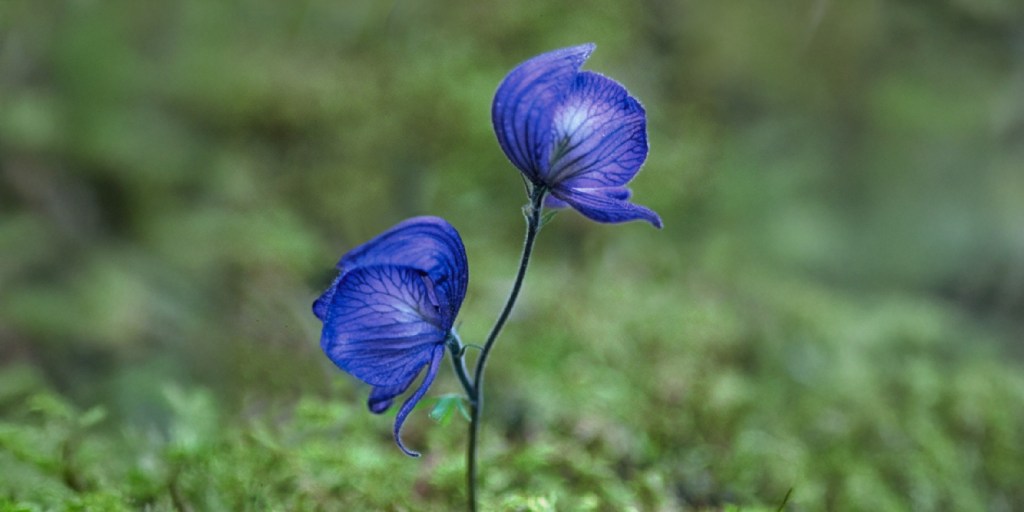
monkshood bloom
the whine of mosquitoes
seems dimnished
~ Ray Rasmussen

red bar

haibun: First published in Simply Haiku, 6:4, Winter 2008.
Ray Rasmussen’s haiku was published in Modern haiku.
Basho’s haiku are translations found at the website titled “Bashล” which cited R.H. Blyth, W.J. Higginson, J. Reichhold and Sam Hamill as among the various translators.

A Commentary on Basho’s Hiraizumi


“Haraizumi” is single passage (aka chapter/haibun) from Basho’s The Narrow Road to the Deep North (Ono no Hosomichi)

“Poetry is the revelation of a feeling that the poet believes to be interior and personal which the reader recognizes as his own.” ~Salvatore Quasimodo

Part I: Commentary

Bashล’s travel journals are some of the earliest examples of haibun and prose passages in early Japanese literature. His journals are accounts of his late-in-life walking journeys through Japan. They are often cited as important reading for serious students of the form and for anyone who writes in the haiku and haibun genres. More generally, they are held up as good reading for anyone who enjoys prose passages mixed with haiku and who wants a glimpse of the spirit of a man who lived several centuries ago.

For this commentary, I’ve selected the passage “Hiraizumi” from The Narrow Road to the Deep North about the demise of the Fujiwara clan. I chose it because as Quasimodo suggests, Bashล expressed a feeling in this piece that I recognized as my own in my recent travels in the Southwest United States. You may wish to read “Hiraizumi” prior to reading this commentary. If so, go here to open a second window.

There are several keys to understanding Bashล’s success in establishing haibun as a serious form of Japanese literature. The first is amount and level of descriptive detail โ€“ what might be called ‘reportage’ โ€“ that provides a context for the poetry that accompanies it. Examples include:

“The ruins of the main gate greeted my eyes a mile before I came upon Lord Hidehira’s mansion, which had been utterly reduced to rice-paddies…”

“The ruined house of Lord Yasuhira was located to the north of the barrier-gate of Koromogaseki, thus blocking the entrance from the Nambu area and forming a protection against barbarous intruders from the north.”

Of course, descriptive detail without some measure of lyrical phrasing would be monotonous. Lyrical passages that touched me included:

“It was here that the glory of three generations of the Fujiwara family passed away like a snatch of empty dream,”

“When a country is defeated, there remain only mountains and rivers, and on a ruined castle in spring only grasses thrive.”

And haibun prose allows a third key element โ€• some telling as well as showing:

“I sat down on my hat and wept bitterly till I almost forgot time.”

A fourth element is Bashล’s closing haiku which can be viewed both as a succinct summary of his feelings, but also as a more general poetic expression about that most serious human foible called ‘war.’ As with many of the haiku in Narrow Road his haiku step out to a new level of insight and lyricism:

summer grasses
all that remains
of soldiers’ dreams

~ Bashล (trans. L. Stryk)

Putting it all together, what is haibun according to Bashล?

โ€ข Rich descriptive detail that sets the stage
โ€ข Poetic phrasings that stir the reader
โ€ข A modest amount of showing as opposed to telling
โ€ข A haiku that steps out from the prose and takes us to a new level of feeling and insight
โ€ข An overall succinctness that allows us to enter and leave a scene in a short reading

While these are the nuts and bolts of haibun, they don’t explain the whole. Haibun is a form of storytelling and these nuts and bolts have to be put together in a way that captivates the reader. As such, haibun prose goes well beyond a typical account of an outing which as Cobb has put it “is often as disorganized and unrooted in thematic content as a set of holiday snaps.”1 Haibun also goes far deeper in its storyline theme than the “go here, see this, eat that, pay this much” type of travel writing that one finds in newspapers and magazines. Of course, good travel writing can also be literary. Nor is haibun mere journalism. As Cobb has put it, “I view the haibun writer as a literary artist, someone who has high regard for authenticity, but not afraid to bend facts when it suits, setting poetic truth above a factual narrative, and free to rearrange chronology.” Cobb further reports that according to Yuasa, Bashล, did indeed “take such liberty as to change the natural course of events, or even invent fictitious events.”

With his long term perspective on the English-language haibun scene, Ken Jones states that “The haibun has come a long way in recent years. Bald narrations of country walks, rendered in flat, deadpan prose, and enlivened only by their haiku (“diamonds in mud banks”) are now mercifully fewโ€”though still occasionally published.”2

Summing up, “Hiraizumi” is a good story with the key compositional elements of haibun to support it. Bashล’s piece takes the reader into the Japan of several centuries ago, into the cultural-historical sensibilities of its people, and into the poetic style of expression that he made famous and that instructs us today, as writers. It is an eloquent statement about the transient nature of our lives and the futility, yet omnipresence, of war.

Part II: A Personal Recognition

“Hiraizumi” brought to mind the ruins that I had recently come upon in one of southern Utah’s sandstone canyons. After hiking several hours, I had found a way down into a remote, seldom-visited place named “Slickhorn Canyon.” There I came unexpectedly on the ruins of ancients who have been given the name “Anasazi” by the Navajos who now occupy the nearby lands.

Some of the ruins looked as if they had been abandoned only yesterday; others were reduced to little more than piles of rubble. Still visible were the finger impressions made when the builders pressed mud as mortar in between the building stones. One spot of mud-mortar had an impression of a baby’s foot.

Bashล doesn’t tell us what led to the demise of the Fujiwara clan, but from the omnipresent wars of our last century and from the records of Japanese historians, we can readily infer the causes. And what about the Anasazi? They disappeared around 1100 AD. While there is neither a written nor an oral remembering of the Anasazi, research from the natural record, the ring thickness of sections of 1000 year old trees and the carbon dating of debris from the sites, tell us that they faced a 100 year drought. We can guess that skirmishes developed between those whose farms had failed and had thus become nomadic raiders and those who had managed to carry on (and sometimes had their farming efforts plundered).

I sat in the shade near one ruin that had handprints painted above the dwelling’s doorway. I could imagine men gathered after a fruitless hunt, women preparing the evening meal from the sparse pickings dictated by a prolonged drought and the children, hungry, perhaps dying of starvation. All about me were pot shards, the broken remains of generations.

Like Bashล, I felt a deep sadness for the plight of these ancient peoples.

Part III: A Conversation of Sorts with Bashล

After reading Bashล haibun, I decided to pen a haibun modeled on “Hiraizumi.” I wanted to explore the structure of his style while utilizing my own experiences in Slickhorn Canyon as context. Whether my piece succeeds or fails is of little importance. Writing it helped me to identify with Bashล’s journey through his Japan. And it reminded me that the plight of the Anasazi is one that has been repeated throughout our disaster- and war-inclined human history, that these ruins were not just interesting artifacts, but places where families and entire clans once lived and then disappeared.

After writing it, I felt as if I had had a deep conversation with a travelling monk who loved to write poetry.


Notes:

1. David Cobb, “A Few Timely Heresies about English Haibun,Blithe Spirit 10:3 September 2000 and reprinted in Haibun Today 5:4 December 2011.

2. Ken Jones, “Writing Reality: Fictional Haibun Stories,” Contemporary Haibun Oonline 3:3, Sept 2007.

3. Ray Rasmussen’s haibun, “Slickhorn Canyon,” which was modeled on Bashล’s “Hiraizumi” is published in Haibun Today 5:4 December 2011.

4. Salvatore Quasimodo, poet and literary critic, was the winner of the Nobel Prize in Literature, 1959.

Basho’s Haibun โ€œHiraizumiโ€: A Commentary

Field at present day Hiraizumi ruins site, Japan . . . all that remains of soldiers’ dreams.

Bashล’s travel journals, purportedly the earliest examples of haibun, are accounts of his late-in-life walking journeys through Japan. They are often cited as important reading for serious students of the form. More generally, they are held up as good reading for readers who enjoy poetic prose and who want a glimpse of the spirit of a man who lived several centuries ago.

For this commentary, I’ve selected the passage “Hiraizumi” from Basho’s The Narrow Road to the Deep North about the demise of the Fujiwara clan. The aim to to explore Basho’s use of haibun and haiku as an exemplar of Japan’s best known haiku and haibun master.

I’ve also added one of my published haibun as an example of a contemporary haibun composition.

Continue reading . . . -> Commentary

A Monkish Guy’s Post-Divorce Journey

Haibun by Ray Rasmussen with poems by Basho

courtesan and monk,
we sleep under one roof together,
moon in a field of clover

~ Basho

Outside, apple blossoms glow in the dusk. She lies on her side, head propped up on a pillow, her eyes telling me that something important is coming, my eyes taking in the candlelight falling on her breasts.

“I need to know more about you,” she says.

โ€œDo you mean about me joking that I’m a monk?โ€

“Yes, because right now you don’t seem very much like a monk.” She glances at my hand wandering slowly along the curve of her hip.

“You’re thinking about Christian monks, the ones who lived in dank cells, ate lentils and hard bread, the ones who whipped themselves. Think instead of Basho, the Japanese monk who traveled extensively, shared his poetry with peasants and samurai nobles, loved flowers, enjoyed the company of women, the warmth of taverns. Think more of a European troubadour with haiku as his song.”

I'm a wanderer
so let that be my nameโ€”
the first winter rain
~ Basho

“Does this mean that I’m just someone who happens to sleep with you?”

“No, but I’ve been a partner all of my life and for now I need not to be.โ€

“So what am I?” she asks. “I don’t know how to tell my friends whatever it is we’re doing. It feels like more than dating or having sex and itโ€™s not friendship because I donโ€™t sleep with my friends.”

how reluctantly
the bee emerges from deep
within the peony
~ Basho

“Canโ€™t we simply enjoy what we have,โ€ I reply.

“I’m reluctant to give up the feel of your skin against mine, but I’ll have to think about this.” She pecks a kiss, dresses and leaves.

A week later her note arrives: “I have such good memories of our moments together. It’s a gift to desire and be desired, but we need such different things.โ€

winter seclusionโ€”
sitting propped against
the same worn post
~ Basho

~ end ~


Author’s comments:

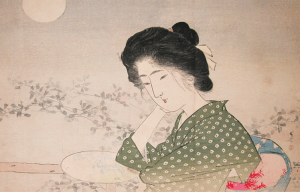
This haibun is my text intertwined with translations of Basho’s haiku and headed by Toshimine’s artwork. It was first published in the journal Simply Haiku.

I thought of this piece as a conversation with two Japanese artists: the haiku by Matsuo Basho, based on his work and poetic sensibilities while living as a traveling poet-monk in 17th century Japan and the woodblock print by “Moon and Bush Clover” by Tsutsui, Toshimine (1863-1934) which he painted on a fan.

Unless we’re Japanese scholars and/or citizens and/or zen practitioners or students of Japanese woodblock art, it’s unlikely we can understand the full illusions and sensibilities of Basho’s poetry and Toshimine’s artwork. Still, his words as translated speak to me and fit my sensibilities as a man growing up in 20th century North America, and in particular, one who found himself immersed in the “dating game” several years after a painful divorce. And there I was, once again, “in seclusion, sitting propped against the same worn post.” In case you’re worried, I’m fortunately paired up now with a wonderful gal who has a firm hold on my heart.

Notes:

All haiku are by Basho. The translations above were found at website titled “Bashoโ€ and cited R.H. Blyth, W.J. Higginson, J. Reichhold and Sam Hamill as translators of various haiku. “A Monk’s Journey” is haibun with a mix of my prose intertwined with translations of Basho’s haiku. It was first published in the journal Simply Haiku. I present it to show how writers can work in conversation, so to speak, with the Japanese masters and other contemporary poets. . . .