
“Love . . . I recall the time when you pierced me. It was that sweet, irrecoverable time, when to youth’s eyes, the world’s unhappy landscape smiles like a vision of paradise.” ~ Giancomo Leopardi (1798-1837)
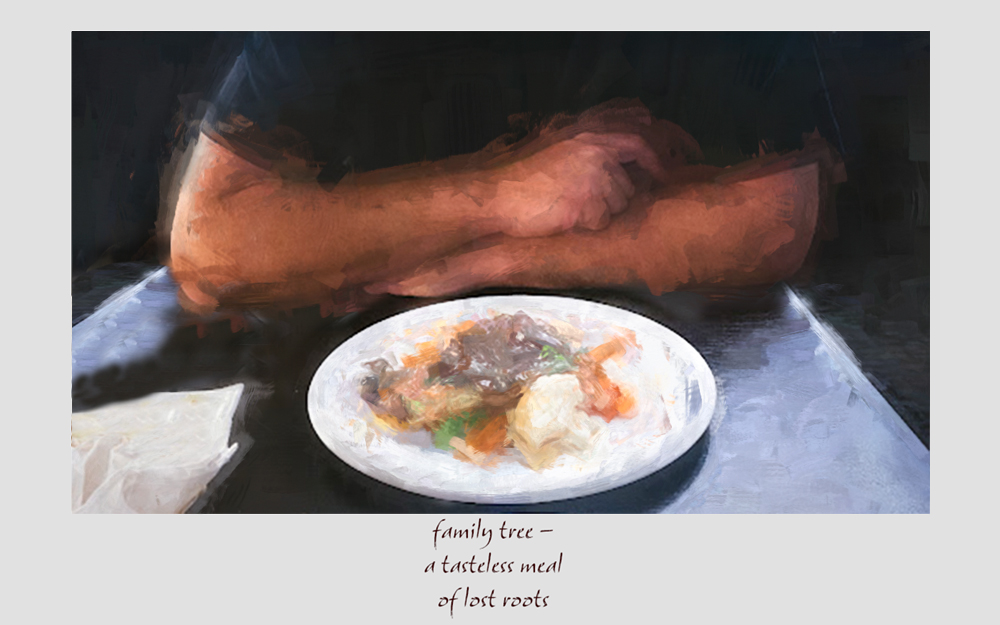
Strapped into a too-narrow, no leg-room Air Canada seat, I’m editing a manuscript, and the distinguished-looking fellow beside me looks over and, in a strong Italian accent, says, “Are you a writer or editor?”
“I’m revising some of my writing,” I reply, and hand him a copy of my last haibun collection, hoping it will keep him quiet while I work.
He starts thumbing through, and I can’t help but notice how little time he stays on each page. Is it that bad? I’m thinking.
But he surprises me with, “I see what you’re doing. This type of writing, haibun is it, is demanding of the reader. My first-year students wouldn’t like it because they haven’t been trained to think. In the prose part, you’re telling a story, which they’d like because they’re used to being fed stories on TV. But that tiny poem at the end of the prose invites them to step out of their cocoons, to make connections.”
“Students? You teach English?” I ask.
“Romance Languages at the University of Toronto,” he says.
Damn, I’ve handed my work to an academic who produces literary criticism. What must he really think?
“You’re Italian, yes?” I ask. He nods, and I mention that my mother is of Italian heritage, but her parents had died in the Spanish Flu. Raised in an orphanage, she hadn’t learned her parents’ language.
“No!” he exclaims, “Terrible to lose your language, your treasured heritage!” He names a number of Italian poets, “Do you know any of them?” And without pausing for my answer, says, “Listen! This is Giacomo Leopardi’s poem ‘First Love.’”
The poem’s rhythms are musical, and his hands and arms are dancing, as if driven by an internal puppet master conducting Leopardi’s music for an audience of one.
His accent and gestures remind me of those rare visits with my aunt and uncle, Laura and Tommaso, who regaled us with stories of the old world.
so little English
yet their hands
sang many songs
He squeezes my arm and confides: “My wife tells me I talk too much. Let me know if I’m boring you and I’ll shut up.”
But I gratefully put my editing aside for the remainder of the flight.
dinner at home –
hands shape
our family’s heritage
Notes
Published in Contemporary Haibun Online, 19.1 2023.
The title is taken from Steven Spielberg’s Close Encounters of the Third Kind, a 1977 science fiction film. It tells the story of a blue-collar worker in Indiana, whose life changes after an encounter with an UFO.
The epigraph is a translation of lines taken from Giacomo Leopardi’s “A Solitary Life,” published in The Canti, in Poetryintranslation website. Italian scholar, poet, essayist and philosopher, Leopardi was one of the great writers of the 19th century. Leopardi’s love problems inspired some of his saddest lyrics. Despite having lived in a small town, Leopardi was in touch with the main ideas of the Enlightenment movement. His literary evolution turned him into one of the well known Romantic poets. (Information taken from the GoodReads website)
 Ray Rasmussen: All Things Haibun Blog
A very contemplative piece that says so much with a beautiful economy of language. What a gift to happen upon a seat companion who focused in on your loss of heritage.
Got me thinking…I knew my grandparents (Scottish immigrants)…so much I wish I had of asked them about their past. Too late.
John
LikeLike
Thanks John, Yes it was a gift to have this guy sit next to me. Best plane rider I ever had.
LikeLike
Thanks for the comment, John. Yes, it would be nice to know more. My sister has taken up doing the family history and I’ve learned some things from that endeavour.
LikeLike